Mob Control
Mob Control
5

Advertisement

  • Info
    OS
    Ios, Android
    Version
    3.25.0
    File Size
    414MB
    Updated
    November 5, 2026
    Developer
    VOODOO
  • Safe
    No virus, No malware, 100% safe

Description

Advertisement

Mob Control is one of those games that explains itself in about ten seconds. You start with a single stickman figure on a track, and your job is to multiply it into a massive crowd, then hurl that crowd at a base full of enemies and smash it apart. That's it. That's the whole pitch. But anyone who's actually played it knows that the "simple idea" is exactly the trick—it's a game built on a tiny mechanical loop that's executed so smoothly it becomes genuinely hard to put down.

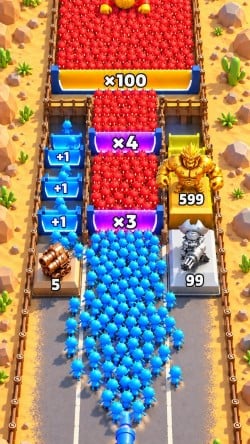
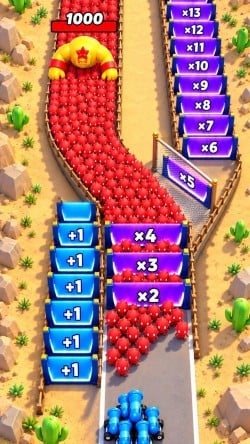
The core concept is a spin on the crowd-runner genre, which became one of mobile gaming's most popular ideas in recent years. You run a group of characters down a straight path while gates pass by on either side. Each gate either multiplies your crowd (say, x2, x3, or a flat +10) or reduces it, and the goal is to route your runners through the multiplier gates to build the biggest mob possible. The bigger your mob gets, the more damage you can deal when you finally launch it at the enemy base at the end of the level. It's a numbers game, a routing game, and a satisfying smash-'em-up all at once.

Where Mob Control differs from the broader crowd-runner crowd is its combat twist. Instead of simply racing to a finish line, you're attacking fortifications. The levels are short shooting galleries of bases, cannons, and mobile enemy units that fire back at your advancing mob. You're not just multiplying—you're managing attrition. The mob you've built up gets whittled down as enemies shoot at it, so the skill isn't just about grabbing the biggest multiplier; it's about timing, positioning, and deciding when to unleash your crowd so it hits with maximum force. That single combat layer elevates the game from "cute running toy" to something with actual moment-to-moment tension.

The Developer: Voodoo and the Hyper-Casual Machine

Mob Control is published by Voodoo, the French company that essentially invented—and still dominates—the hyper-casual genre. Voodoo started as a mobile game publisher in France and grew into one of the biggest forces in casual gaming, with a catalog that includes some of the most downloaded games in mobile history. Their name is practically synonymous with the hyper-casual category: short, simple, endlessly replayable games, usually free to play, that rely on quick sessions and clever mechanics to become viral.

Mob Control fits that Voodoo mold perfectly. It was built on a genre template—the crowd runner—that Voodoo had already proven could be wildly popular. But rather than just pumping out another clone, they took a well-understood mechanic and added a distinct hook: the base-smashing combat. It's a textbook example of Voodoo's approach—take a proven loop, sharpen the execution to a level where it feels polished and responsive, and make it easy for players to share with friends and for advertisers to slot into. The publisher's playbook has long been built on mass-market appeal, and Mob Control is one of its cleaner successes.

One useful context point: Mob Control was developed under Voodoo's expansive network of in-house and partner studios, and Voodoo has historically worked with many small developers. What matters most for players is that the game carries Voodoo's signature polish—the feel of a well-tuned, fast-loading, ad-supported hyper-casual game. The company's business is built on scaling simple, low-cost games to massive downloads, and Mob Control's massive player base is proof of how effective that approach can be when the core mechanic clicks.

Core Gameplay Loop: Multiply, Avoid, Attack

The basic moment-to-moment loop in Mob Control is a classic one, and it breaks down into three distinct phases per level. First, the buildup: you guide your mob through a corridor filled with gates, choosing which gates to pass through to maximize your crowd. Gates can double it, triple it, add a flat number, or cut it down, and the routing decisions you make in those early seconds determine how strong your mob is going to be. Second, the survival phase: as your mob advances, enemy turrets and cannons open fire. You watch your numbers shrink and make adjustments, sometimes deciding to sprint forward, sometimes to hold back. Third, the attack phase: at the end of the level, you launch your crowd at the enemy's core, and the game calculates the damage based on mob size and impact.

That final "launch" is the emotional payoff the whole level builds toward. Watching your crowd—potentially hundreds of little stickmen—crash into an enemy base and demolish it in a satisfying explosion of numbers and effects is the game's signature moment. If your mob broke through, you win and move on. If it wasn't big enough, you lose and try again. The win/fail condition is so immediate and legible that you always understand exactly why you failed, and that legibility is crucial to a hyper-casual game's addictive quality—you always think "one more try will work."

What keeps the loop from getting stale is the steady drip of new elements. Over the game's long history, Voodoo has added new level types, new enemy mechanics, new upgrades, and new progression systems that keep the basic "multiply-and-smash" loop feeling fresh. There are boss levels, special gates, power-ups, and eventually base upgrades that change how strong your mob and your base actually are. For a game whose core takes about ten seconds to understand, the designers have squeezed an impressive amount of depth into the space around it.

The Arsenal: Upgrades, Cannons, and Base Defense

Mob Control isn't only about running your mob at the enemy—it also puts a version of the reverse mechanic in your hands. Your own base can be upgraded and defended with cannons and turrets, and over time you build an arsenal of weapons that fire at incoming mobs. This adds a second layer of gameplay: when you return to your base, you're not just collecting rewards, you're improving its defenses. It also means the game has a light competitive element, since other players' mobs can attack you and your defenses can fight back.

The upgrade system is where the game's long-term progression lives. You earn resources from winning levels, and you spend them on upgrading your mob's capacity, your base's health, and your defenses. There's usually a tiered structure: each upgrade level costs more but yields more power, and the journey from a small-time runner to a fortified stronghold is the backbone of long-term motivation. Cannons in particular are satisfying to unlock and upgrade—they give you the ability to actively fight back, and watching a wall of enemy stickmen get shredded by your defenses is just as satisfying as demolishing someone else's base.

This arsenal layer also adds a strategic texture that pure runners lack. Since your base can be attacked, you have a reason to care about defense, and since your mob can be boosted, you have a reason to chase upgrades. The two sides of the game—offense through your mob, defense through your cannons—create a feedback loop that makes every upgrade feel like it's serving a purpose. For a hyper-casual game, that's a genuinely well-constructed progression system.

The Shooter and Boss Fights: Action Bursts

Beyond the pure runner, Mob Control periodically throws in special action sequences. Some levels feature boss encounters—bigger, tougher enemies that require a larger mob or a different approach to crack. Other modes introduce more direct combat moments, where the game shifts slightly from "route through gates" to "manage a fight." While these are still rooted in the multiply-and-smash formula, they add variety and help the game avoid the sameness that can plague long-running hyper-casual titles.

The boss fights are the game's natural "climax" moments. They force you to build a bigger mob, manage the approach more carefully, and accept that a single wrong turn might mean failure. Because these levels tend to be featured as milestones, they give players a clear goal to aim for—something to look forward to, and something to celebrate when it's cleared. For a game with such simple mechanics, these punctuated challenges do a lot of work in keeping players coming back.

Target Audience: Who Is Mob Control For?

Mob Control's audience is deliberately broad. At its heart, it's designed for casual mobile players—people who want something quick, satisfying, and easy to understand, and who don't want to learn a deep strategy game. It's the kind of title you open for a few minutes in line, on the bus, or on the couch with a TV in the background. The controls are minimal, the levels are short, and the payoff is immediate, which makes it hugely approachable for players of almost any age.

Its natural audience spans a wide range. Kids and teens find the stickman graphic style and the satisfying destruction instantly appealing. Older players enjoy it as a low-pressure way to kill a few minutes. Game players who enjoy optimization—people who like to plan the perfect route through a level—get a puzzle-like hook out of the multiplier gates. And its heavy use of short-session design and rewarded ads makes it attractive to the kind of mass-market audience that Voodoo games have always reached: people who don't identify as "gamers" but who will happily play a five-minute mobile game several times a day.

It's also a game for people who like progression. There's a compelling long-term upgrade loop: you're always working toward the next level of mob capacity, the next cannon upgrade, the next unlocked hero or weapon. For a casual game, that's a surprisingly strong draw and it's part of why Mob Control has been able to hold onto players for years rather than fading like so many hyper-casual flashes in the pan.

Read more

Screenshots

Download

Download
Verified antivirus
All link sources on this site are jumped to App Store, Google Play and other official platforms. No virus, no malware.

How to Play

The Core Idea: One Stickman, One Goal

Mob Control's gameplay begins with the simplest possible premise: you start each level with a single tiny stickman, and your job is to turn that one figure into a massive crowd, then launch that crowd at an enemy base and destroy it. That's the entire fantasy. No complex menus, no tutorial overload, no learning curve to speak of. You tap and hold, you move your crowd left and right, and you make choices as gates flash past on either side of the track. Within thirty seconds of your first level, you already understand what the game wants from you. But understanding the idea is different from mastering it, and that's where Mob Control's surprisingly deep gameplay lives.

The key thing to grasp right away is that this isn't just a reflex game. It's a routing puzzle dressed up as an action game. Every gate you pass through changes your mob's size, and since the size of your mob at the end of the level determines whether you can break the enemy base, the entire level is essentially a decision tree. Do you take the x3 gate early but then face a series of reducing gates? Do you hold out for the flat +10 gate that avoids the risk of a bad multiplier? Do you route through a smaller gate to avoid the corridor with the enemy turret? Each choice has consequences, and those consequences play out fast. The best players aren't just tapping quickly—they're reading the level's layout and choosing their path deliberately.

And then there's the tension. As your mob runs, enemy cannons and turrets open fire, shrinking your crowd with every hit. That steady attrition means your multiplier choices aren't just about maximizing your number—they're about maximizing your number while surviving the journey. A mob that's huge but gets shredded before it reaches the base is useless. A mob that's smaller but makes it to the base intact wins. That balance between growth and survival is the real skill in Mob Control's gameplay, and it's what separates a decent player from a great one.

The Three Phases of Every Level

Every level in Mob Control follows a clear three-phase structure, and understanding each phase is the foundation of playing well. The first phase is the buildup. This is where the track begins, and it's usually the calmest section of the level. Gates start appearing, offering multipliers and flat bonuses, and you make your first big routing decisions. The goal here is to grab as much growth as you can without biting off a route that traps you later. Experienced players often have a rough plan in mind from the second the level loads—they're looking ahead to see which corridor has the best gate sequence and which has the deadliest turrets.

The second phase is the gauntlet. This is where the level gets dangerous. Enemy turrets, cannons, and mobile units start firing at your advancing mob, and your numbers begin to dwindle. The game becomes a balancing act. Sometimes you need to push forward aggressively to reach the next set of multiplying gates before your mob shrinks too much. Sometimes you need to weave slightly to avoid a concentrated firing line. The gauntlet is where most levels are won or lost, and it's the part of the gameplay that rewards the most skill—reaction, planning, and a feel for how much your mob can take.

The third phase is the attack. At the end of the track, you slam your crowd into the enemy base. The game calculates damage based on the size and power of your mob, and the base either crumbles or stands. If it crumbles, you win and collect your rewards. If it stands, you lose, and the game almost always makes it clear why—you didn't build enough, or you lost too many on the way. That clarity is essential to Mob Control's design: you never feel cheated, you feel motivated to try again with a better route.

Gates, Power-Ups, and the Art of Routing

The gates are the heart of Mob Control's routing puzzle, and the variety of gate types is what gives the game its strategic texture. Basic multiplier gates—x2, x3, sometimes higher—are the main way to grow your mob, but they're often placed in risky corridors. Flat-addition gates, the +10s and +20s, are safer and more consistent, and they're often the smarter choice when the level ahead is loaded with turrets. Then there are the reduce gates, the traps designed to punish sloppy routing—pass through one and you might lose half your crowd. The game is constantly tempting you to take the biggest multiplier, and the skill is knowing when that temptation is a mistake.

Power-ups layer another dimension on top of the gates. You'll find items scattered around the track that can boost your mob's speed, grant temporary invincibility, increase your damage, or even double your crowd instantly. Some power-ups are timed—you have to grab them and benefit from them quickly—while others act as permanent buffs for the rest of the level. Clever players combine power-ups with gate choices to create "combo" runs—picking up a speed boost

 to sprint through a multiplier gate before turrets can fire, for example. The power-up system is simple on the surface but rewards players who experiment and learn how the pieces fit together.

The result is a level design that's deceptively rich. A short corridor with three gates can offer several genuinely different strategic paths, and the difference between the best route and the worst can be the difference between a clean win and a frustrating loss. That replayability is exactly what makes the game so sticky—players feel like they're solving a puzzle each time, not just tapping a screen.

Upgrading Your Arsenal: Mobs, Cannons, and Hero Units

Mob Control's gameplay extends far beyond a single run. Between levels, you're building and upgrading your arsenal, and this progression is where the game's long-term depth lives. First, your mob itself can be upgraded. You can increase your starting crowd size, improve the multipliers you get from gates, and raise the damage your mob deals when it hits a base. These upgrades are the foundation of your long-term power, and they're the first thing most players spend their rewarded resources on.

Second, and more importantly, is the cannon system. Your base isn't just a target—it's a defensive fortress, and you're constantly upgrading it. Cannons and turrets fire at attackers, and you can unlock new types, upgrade their damage and firing rate, and customize your defenses. This flips the game's dynamic: instead of always being the attacker, you also have to worry about defending your own base, because in the game's competitive and progression systems, other players' mobs can attack you. The cannon upgrade path is satisfying because it's so direct—you can see your defenses get stronger and watch them shred bigger and bigger enemy mobs.

Then there are hero units and special weapons. As you progress, you unlock powerful character units and devastating weapons that can turn the tide of a battle. These are often unlocked at specific progression milestones, and they're the "prestige" content that gives long-term players something serious to chase. They also add variety to the core loop—some levels feel very different because of the special units or weapons available.

Boss Fights and Special Levels

Not every level is a standard run. Mob Control periodically throws in boss battles and special events that shake up the formula. Boss levels feature a single massive enemy structure with far more health than a normal base, and they demand a genuinely large, well-managed mob to crack. These levels often have different gate layouts, unique power-ups, and special hazards, so they force players to approach them with fresh strategies. Boss battles function as milestone moments—they're harder, they're more dramatic, and clearing them feels like a real achievement.

Special event levels and limited-time modes add further variety. The game has featured events with altered rules, seasonal content, and challenges that reward players for completing difficult runs. These events keep the core gameplay from becoming repetitive, and they give dedicated players a reason to keep coming back. For a hyper-casual game, this kind of event-driven content is how you keep a huge audience engaged over years rather than weeks.

The Competitive Layer: Attacking and Defending

A surprising amount of Mob Control's gameplay is about other players. The game tracks your base and your defenses, and other players' mobs can attack them—and you can attack theirs. This creates a light competitive loop that gives the upgrades real meaning. Your mob upgrades matter because they determine how well you can attack others. Your cannon upgrades matter because they determine how well you can defend against incoming attacks. It's not a deep competitive system by strategy-game standards, but it's enough to make the progression feel purposeful and to give the game a social dimension.

The competitive loop works because it's so easy to engage with. You don't need to coordinate with teammates or manage complex timers. You just hit the "attack" button when you're ready, and you watch the battle play out. Win, and you take some of the other player's resources. Lose, and you're reminded of the value of upgrading. It's simple, immediate, and it keeps the game's broader economy moving. For a casual game, that's a smart and effective design.

The Daily Loop and Why It Sticks

Ultimately, Mob Control's gameplay is designed around a daily habit. Each session is short—a few minutes to run a couple of levels, upgrade something, maybe watch a rewarded ad for a bonus, and attack a base or two. There's always a next goal: the next cannon upgrade, the next mob size increase, the next boss to defeat. The game's feedback is immediate and satisfying—numbers go up, things explode, progress is visible. That's the essence of the hyper-casual formula, and Mob Control executes it with unusual polish.


Read more

Coming soon to the
Are you sure you want to continue?